
Burundi
Burundi remains one of the least developed countries (ranked 187 out of 191 countries on the Human Development Index in 2022) with a low-income economy.
Climate displacement in Burundi
Burundi remains one of the least developed countries (ranked 187 out of 191 countries on the Human Development Index in 2022) with a low-income economy. With more than 80 per cent of the population employed in the agricultural sector, Burundi's economy remains fragile and vulnerable to climate shocks and environmental degradation. The country is exposed to natural hazards, including torrential rains, floods, landslides, coastal and soil erosion, strong winds and hail, which pose significant threats to almost every sector of the country, and to the livelihoods of communities. The impacts of flooding and landslides are the main drivers of internal displacement. As of November 2024, Burundi had 86,159 internally displaced persons (IDPs), 91 per cent of whom were displaced by disasters, with 26 per cent being children and 55 per cent being women and girls (IOM Displacement Tracking Matrix, November 2024). Most IDPs live with host families while others remain in displacement sites. Burundi experienced extremely heavy rains during the 2023-2024 El Niño event. As of June 2024, it is estimated that over 300,000 people have been affected by flooding around Lake Tanganyika, triggering more than 80,000 disaster displacements. Displacement is increasing and becoming recurrent and protracted as a direct consequence of climate change and environmental degradation.
Climate-related displacement is not just a rural issue—it increasingly affects urban areas as well. In cities where rapid growth is poorly planned, such as Bujumbura, the lack of proper urban development has led to the spread of informal settlements in vulnerable areas. These settlements often lack basic infrastructure and are built in risky zones prone to floods and landslides. As climate change intensifies extreme weather events, the combination of unregulated urban sprawl and inadequate services, such as inefficient drainage systems, amplifies the impact of geo-hydrological hazards. This results in rising displacement within cities, especially among populations living in precarious housing conditions
Read the full country context
With improvements in the socio-political situation in recent years, 254,100 Burundian refugees have returned from neighboring countries since 2017 through the United Nations High Commissioner for Refugees' (UNHCR) voluntary repatriation programme Remnants of the 2015 crisis remain a source of instability and the return of refugees, particularly from Tanzania, is creating tensions owing to competition over inequitably distributed natural resources and access to land. Burundi has a significantly low Human Development Index (ranked 187 out of 191 countries on the HDI in 2022) with a low-income economy. With more than 80 per cent of the population engaged in the agricultural sector, mainly in subsistence farming, Burundi's economy remains fragile and vulnerable to climate shocks and environmental degradation. With the increased number of IDPs and returnees, conflict over land and resources is a major challenge, exacerbating existing vulnerabilities and exposure to natural hazards.
The country already faces a major problem of access to productive land due to a combination of factors, including the very steep nature of watersheds, which makes them very vulnerable to erosion, the loss of soil fertility due to the topography and unsustainable farming practices, but also the excessive fragmentation of cultivated land as a result of inheritance. This problem of access to land, in turn, has a negative impact on the management of natural resources, as it further encourages farming households to adopt unsustainable practices, such as excessive use of chemical inputs, but also the expansion of arable land at the expense of forests and other natural ecosystems.
These developments are taking place against a backdrop of particularly weak legislation on natural resource management. The latter is characterized by a lack of legal texts but also a poor enforcement of existing legislation. Indeed, the Water Code and the Environment Code (last revised in 2021) exist, but they do lack the implementing texts to be fully effective. The Land Code and Forest Code are also available, but they need to be reinforced by implementing decrees and monitoring of compliance. Thus, natural ecosystems face numerous constraints and threats, due notably to the vulnerability of rural and urban communities, as mentioned above, but also to the lack of concerted development planning, the authorities' lack of capacity to enforce the law, illegal gold mining, and insecurity due to the presence of various armed groups. Against this background, the Action aims to strengthen the administration and public authorities in the areas of natural resource management and climate-related displacement, but also to strengthen the latter through participatory governance tools, piloted and managed by the communities concerned.
The Action is in line with the strategic orientations developed by Burundi, as outlined, among others, in the National Development Plan 2018-2027, which includes in its strategic axis 3 the dimension of "human rights and public freedoms", with a special focus on people affected by disasters. It is also in line with the 2022-2032 National Strategy for the Conservation of Protected Areas and the National Strategy for the Sustainable Socio-Economic Reintegration of Disaster-Affected People and the Inclusion of the Batwa in Burundi 2023-2027, led by the Ministry of National Solidarity, Social Affairs, Human Rights and Gender. It also takes into account the National Gender Policy 2012-2025, implemented by the same ministry. It is also in line with Burundi's commitments at the Global Refugee Forum to promote the integration of displaced persons in the country. Finally, the Action contributes to the objectives of the EU Multiannual Indicative Programme 2021-2027 for Burundi, in particular in Priority Areas 1 and 2 (namely (i) inclusive, sustainable and green growth and job creation, and (ii) human development and basic services). The programme is also in line with the EU's strategic priorities and contributes to Sustainable Development Goals 15 ("Life on Land"), 6 ("Water and Sanitation"), 2 ("Zero Hunger") and 5 ("Gender Equality").
Excerpted from the RE2CLID Technical Implementation Package: Burundi (indicative; may change during inception).
What RE2CLID will do
Disaster forecasts & displacement management
In Burundi, gender-responsive disaster risk management systems will be reinforced to account for the specific vulnerabilities and needs of women and girls, who are disproportionately affected by displacement and underrepresented in disaster governance structures. Women and girls face heightened exposure to gender-based violence (GBV), limited access to early warning information, and systemic barriers to participation in decision-making processes - particularly in a socio-cultural context where traditional gender norms can hinder their engagement. IOM will adopt a rights-based and intersectional approach to ensure that risk communication, contingency planning, and preparedness systems include the voices and priorities of women, including those living with disabilities and female heads of households. Activities will include the integration of gender and protection indicators into early warning systems, training for DRR committees on inclusive preparedness, and support for female leadership within local DRR platforms. Furthermore, IOM will establish GBV risk mitigation, reporting, and response mechanisms linked to disaster displacement events, ensuring affected populations, particularly displaced women and girls, can access safe, confidential, and culturally appropriate support services.
Natural resource governance
In Burundi, the design and implementation of natural resource management mechanisms will be reinforced. The involvement of displacement-affected communities and the most vulnerable populations will not only make these mechanisms more inclusive but also more sustainable and effective in mitigating the risks of climate-related displacement. The economic empowerment of DACs through sustainable resource management will be promoted, including gender-responsive support for the livelihoods of women and marginalized groups. The Action aims to leverage the circular economy to stimulate the development of off-farm income-generating activities within DACs, particularly in areas hosting large numbers of displaced people and/or where natural resources are under significant pressure. Finally, the capacities of public administration and local actors will be strengthened to effectively address displacement, sustainable resource management, and climate adaptation. Coordination mechanisms at both national and sub-national levels will be reinforced to ensure an integrated, inclusive, and gender-responsive approach to these challenges.
Resilience & self-reliance
An integrated package of durable solutions interventions will strengthen the resilience and self-reliance of DACs in the climate-vulnerable and environmentally fragile areas along the Lake Tanganyika shoreline. Livelihood diversification initiatives will provide vocational training and support the development of small enterprises, equipping individuals with income-generating skills and microbusiness start-up resources to reduce economic vulnerability. Simultaneously, climate-resilient infrastructure and shelter rehabilitation will focus on upgrading disaster-prone housing, improving drainage systems and access roads, and restoring essential public services such as schools and health centers. These efforts will be complemented by improved access to basic services, including the rehabilitation of water points, the construction of ecological latrines, and the development of market infrastructure to enhance local trade. In zones facing recurrent flooding or landslides, planned relocation programs will enable at-risk families to resettle in safer areas with durable housing and essential services, in close coordination with government-led initiatives. This comprehensive approach is fully aligned with the UN Secretary-General’s Action Agenda on Internal Displacement, particularly its focus on promoting self-reliance, scaling up solutions in climate-affected areas, and reinforcing national leadership and coordination mechanisms.
Location selection
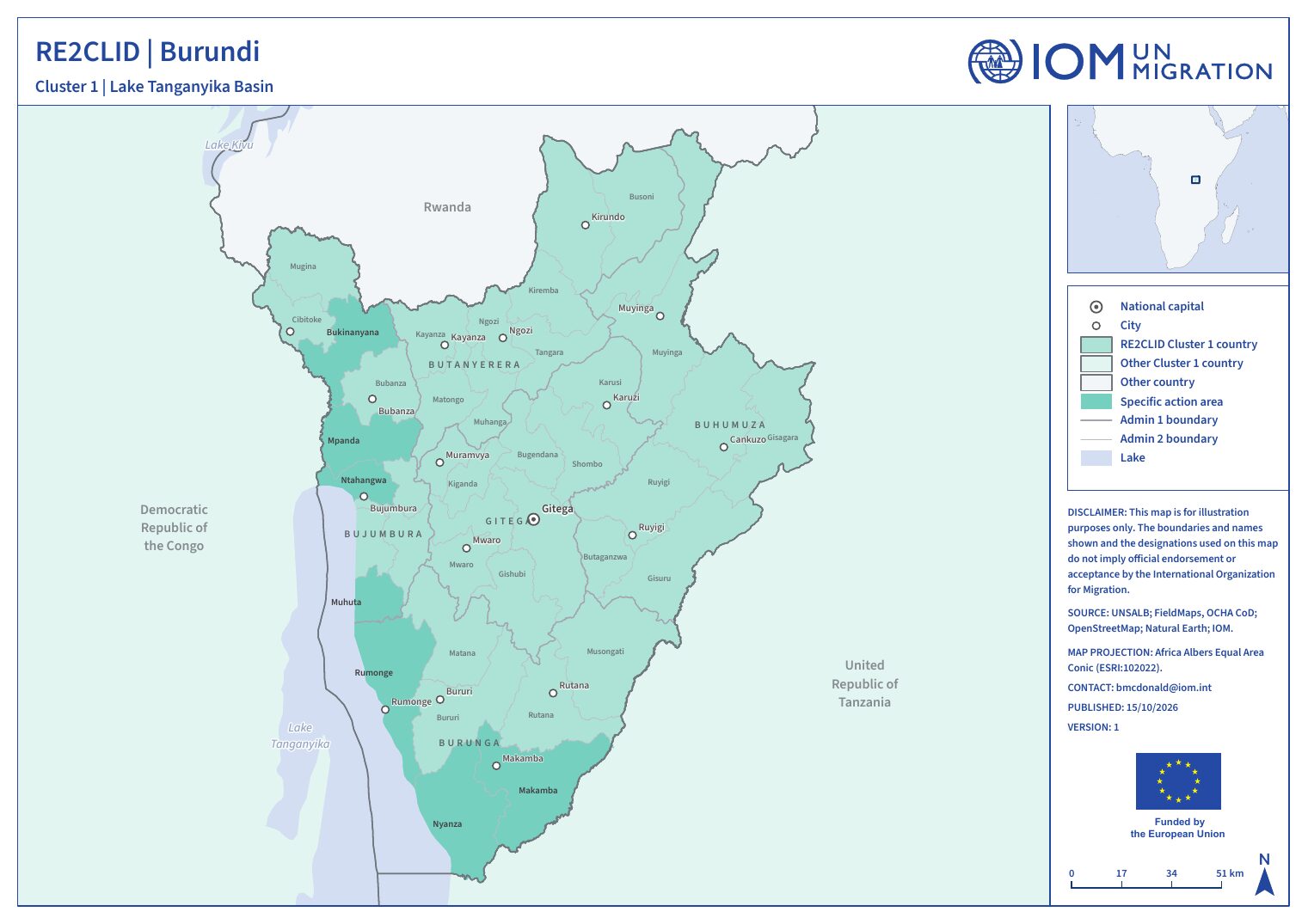
In alignment with recommendations made in the Regional Responses to Climate Displacement (RE2CLID) Final report from October 2024, the Action will target the Lake Tanganyika shoreline, extending from the Rusizi River watershed north of Bujumbura province down to the Tanzanian border. It will focus on watersheds and rivers upstream and downstream of Bujumbura and Rumonge cities, touching the new provinces of Bujumbura and Burunga (formerly, Bujumbura Mairie, Rurale, Rumonge and, tangentially, Cibitoke, focusing on Buganda commune – Gateri site). Interventions under Strategic Objective (SO) 1 will be implemented at the regional and national level, focusing on enhancing policy, coordination, and institutional frameworks. Interventions under SO 2 and SO 3 will be concentrated at the community level, specifically within Lake Tanganyika coastal areas, addressing site-specific vulnerabilities and needs. Under, SO 2 the intervention will adopt a double anchoring approach, combining a geographical targeting at community level while simultaneously engaging central institutions through targeted support.Specific intervention locations at the lower governance levels are to be agreed upon between the Government of Burundi, the EUD, IOM and Enabel.
District profile summary
Districts (admin-2) in the RE2CLID action areas, with the seasonal hazards and peak-pressure months from their action-area calendar. CVA results will be added as each district analysis is completed.
| District | Admin-1 | Action units | Seasonal hazards & outbreaks | Peak pressure | CVA |
|---|---|---|---|---|---|
| Bukinanyana BI202 | Bujumbura | 2 | Rainy season, Malaria | Oct–Apr | Pending |
| Mpanda BI205 | Bujumbura | 1 | Rainy season, Malaria | Oct–Apr | Pending |
| Muhuta BI208 | Bujumbura | 1 | Rainy season, Malaria | Oct–Apr | Pending |
| Ntahangwa BI210 | Bujumbura | 1 | Rainy season, Malaria | Oct–Apr | Pending |
| Makamba BI302 | Burunga | 1 | Rainy season, Malaria | Oct–Apr | Pending |
| Nyanza BI305 | Burunga | 2 | Rainy season, Malaria | Oct–Apr | Pending |
| Rumonge BI306 | Burunga | 2 | Rainy season, Malaria | Oct–Apr | Pending |
Burundi action areas
Click a district to open its profile.
- Action area (admin-1)
- District (admin-2)
Seasonal calendar
Recurring seasonal hazards, agricultural seasons, lean periods and outbreaks. Switch between the national calendar and each action area, and use the chips to filter categories.
Today. Events are recurring seasonal patterns, not forecasts.
Calendar narrative & sources
ACAPS lists 20 seasonal events for Burundi, all of them country-wide.
The recorded seasonal hazards are the rainy season (Sep–Dec) and the rainy season (Feb–Apr). Planting and growing periods: Main planting – Maize (Sep–Oct), Main planting – Sorghum (Sep–Oct), Main planting – Land preparation (Oct–Jan), 2nd planting – Maize (Feb–Mar), 2nd planting – Sorghum (Feb–Mar), 2nd planting – Land preparation (Mar–May) and 3rd planting – Land preparation (Jun–Aug). Harvests: the 3rd harvest (Sep–Nov), the main harvest (Dec–Feb), the main harvest – Maize (Jan–Feb), the main harvest – Sorghum (Jan–Feb), the 2nd harvest – Sorghum (Jun–Jul), the 2nd harvest (Jun–Aug) and the 2nd harvest – Maize (Jun–Jul). The lean season runs from September to December and from February to May. Disease outbreaks follow a seasonal pattern: malaria (Oct–Dec) and malaria (Mar–May).
The 20 records come from 3 sources dated 2013 to 2023. Entries more than 10 years old should be checked against current FEWS NET, FAO GIEWS or national meteorological calendars before use in planning.
- FEWS NET (2013-12-18), via ACAPS Seasonal Events Calendar. fews.net/fr/east-africa/burundi
- USDA (2023-02-08), via ACAPS Seasonal Events Calendar. ipad.fas.usda.gov/countrysummary/Default.aspx?id=BY
- Severe Malaria Observatory (2023-04-13), via ACAPS Seasonal Events Calendar. www.severemalaria.org/fr/pays/burundi
Burundi country analysis
The country CVA applies the common methodology with national data and partners. It runs multi-hazard displacement vulnerability and risk assessments, and its results feed into risk-informed preparedness, DRR and adaptation planning at national and sub-national levels.
Questions the country analysis will answer
- Which districts and communities are most exposed to the main seasonal and sudden-onset hazards?
- How do socio-economic vulnerability and adaptive capacity differ between action areas?
- How can results be built into national DRM, early warning and anticipatory action systems?
Analytical dimensions
- 1Hazard
Sudden-onset (floods, cyclones, landslides) and slow-onset (lake-level rise, drought, degradation) - 2Exposure
People, settlements, infrastructure and livelihoods in hazard-prone areas - 3Vulnerability
Socio-economic sensitivity, disaggregated by sex, age and disability - 4Adaptive capacity
Services, institutions, social protection and coping strategies - 5Displacement risk
Combined likelihood and scale of disaster displacement
Outputs for Burundi
- Analysis report · Quarto web pagePending
- Summary brief · PDFPending
- Briefing slides · Quarto Reveal.js slidesPending