
Mozambique
Mozambique is among the countries most exposed to tropical cyclones, floods and drought in the South-West Indian Ocean basin.
Climate displacement in Mozambique
Mozambique is among the countries most exposed to tropical cyclones, floods and drought in the South-West Indian Ocean basin. Cyclone Gombe alone affected over 700,000 people and displaced 23,000, and the 2023–2024 El Niño dry spell caused widespread crop failure across Southern Africa.
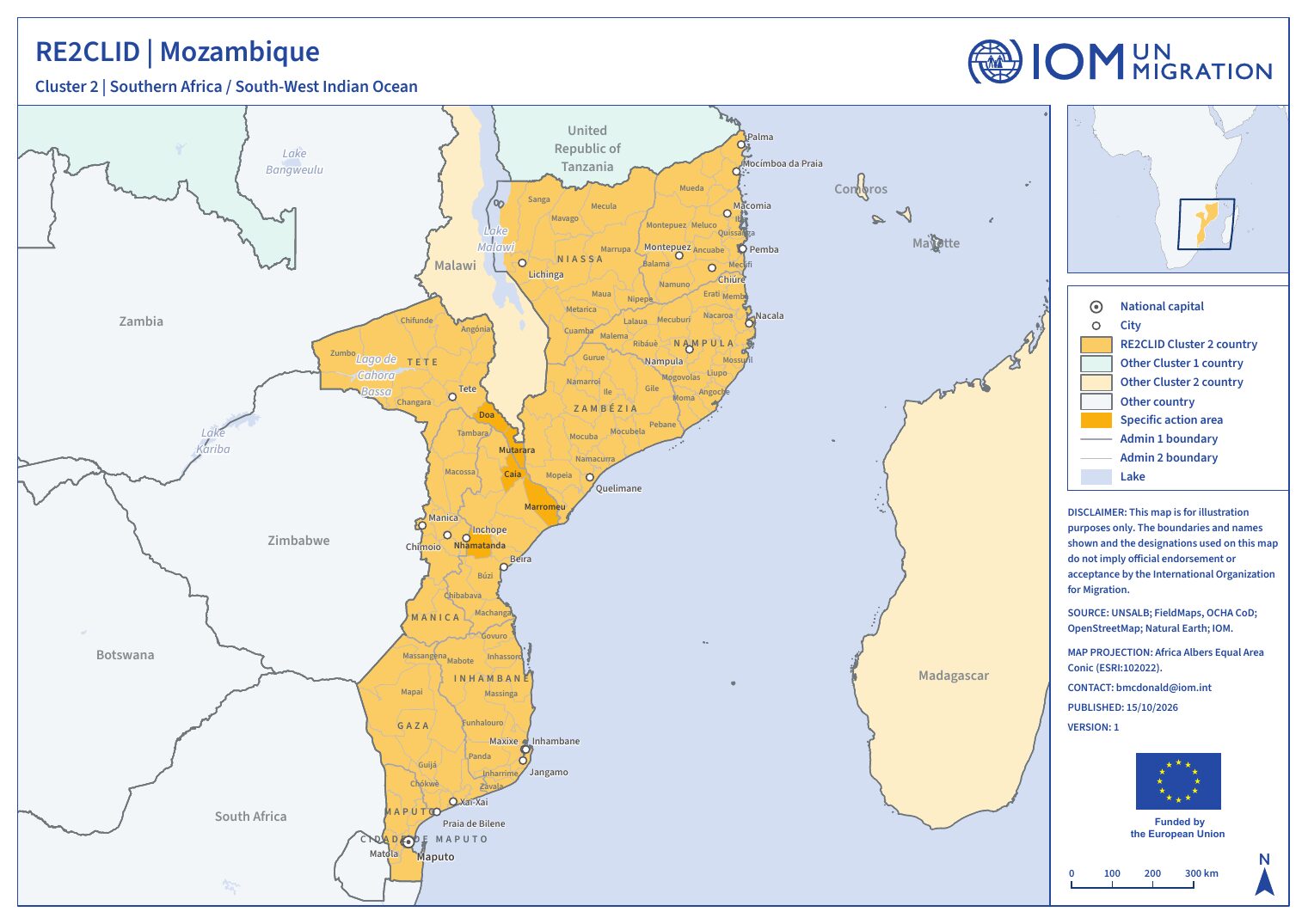
RE2CLID targets action areas in Sofala and Tete provinces, with WFP as programme partner in Mozambique. A Technical Implementation Package for Mozambique was not included in the source pack, so this summary uses the cluster Description of the Action.
Summary drawn from the Cluster 2 Description of the Action. The country TIP is not yet in the source pack.
What RE2CLID will do
District profile summary
Districts (admin-2) in the RE2CLID action areas, with the seasonal hazards and peak-pressure months from their action-area calendar. CVA results will be added as each district analysis is completed.
| District | Admin-1 | Action units | Seasonal hazards & outbreaks | Peak pressure | CVA |
|---|---|---|---|---|---|
| Mutarara MZ0511 | Tete | District-wide | Cyclone season, Rainy season | Oct–Jan | Pending |
| Doa MZ0514 | Tete | District-wide | Cyclone season, Rainy season | Oct–Jan | Pending |
| Caia MZ0703 | Sofala | District-wide | Cyclone season, Rainy season | Oct–Jan | Pending |
| Marromeu MZ0711 | Sofala | District-wide | Cyclone season, Rainy season | Oct–Jan | Pending |
| Nhamatanda MZ0713 | Sofala | District-wide | Cyclone season, Rainy season | Oct–Jan | Pending |
Mozambique action areas
Click a district to open its profile.
- Action area (admin-1)
- District (admin-2)
Seasonal calendar
Recurring seasonal hazards, agricultural seasons, lean periods and outbreaks. Switch between the national calendar and each action area, and use the chips to filter categories.
Today. Events are recurring seasonal patterns, not forecasts.
Calendar narrative & sources
ACAPS lists 14 seasonal events for Mozambique, 14 of them limited to specific admin-1 areas (shown in brackets).
The recorded seasonal hazards are the rainy season in Gaza, Inhambane, Manica, Maputo, Maputo City, Sofala, Tete (Oct–Mar), the cyclone season in Gaza, Inhambane, Manica, Maputo, Maputo City, Sofala, Tete (Oct–Mar), the rainy season in Cabo Delgado, Nampula, Nassa, Zambezia (Nov–Apr) and the cyclone season in Cabo Delgado, Nampula, Nassa, Zambezia (Nov–Apr). Planting and growing periods: Main planting in Gaza, Inhambane, Manica, Maputo, Maputo City, Sofala, Tete (Oct–Dec), Land preparation in Cabo Delgado, Nampula, Nassa, Zambezia (Sep–Oct), Main planting in Cabo Delgado, Nassa, Zambezia, Nampula (Nov–Jan), 2nd planting in Gaza, Inhambane, Manica, Maputo, Maputo City, Sofala, Tete (May–Jul) and Land preparation in Gaza, Inhambane, Manica, Maputo, Maputo City, Sofala, Tete (Aug–Sep). Harvests: the main harvest in Gaza, Inhambane, Manica, Maputo, Maputo City, Sofala, Tete (Mar–May), the main harvest in Cabo Delgado, Nampula, Nassa, Zambezia (Apr–Jun) and the 2nd harvest in Gaza, Inhambane, Manica, Maputo, Maputo City, Sofala, Tete (Jul–Aug). The lean season runs from October to January in Gaza, Inhambane, Manica, Maputo, Maputo City, Sofala, Tete and from December to March in Cabo Delgado, Nampula, Nassa, Zambezia.
The 14 records come from 1 source dated 2013. Entries more than 10 years old should be checked against current FEWS NET, FAO GIEWS or national meteorological calendars before use in planning.
- FEWS NET (2013-12-14), via ACAPS Seasonal Events Calendar. fews.net/southern-africa/mozambique/seasonal-calendar/decemb
Mozambique country analysis
The country CVA applies the common methodology with national data and partners. It runs multi-hazard displacement vulnerability and risk assessments, and its results feed into risk-informed preparedness, DRR and adaptation planning at national and sub-national levels.
Questions the country analysis will answer
- Which districts and communities are most exposed to the main seasonal and sudden-onset hazards?
- How do socio-economic vulnerability and adaptive capacity differ between action areas?
- How can results be built into national DRM, early warning and anticipatory action systems?
Analytical dimensions
- 1Hazard
Sudden-onset (floods, cyclones, landslides) and slow-onset (lake-level rise, drought, degradation) - 2Exposure
People, settlements, infrastructure and livelihoods in hazard-prone areas - 3Vulnerability
Socio-economic sensitivity, disaggregated by sex, age and disability - 4Adaptive capacity
Services, institutions, social protection and coping strategies - 5Displacement risk
Combined likelihood and scale of disaster displacement
Outputs for Mozambique
- Analysis report · Quarto web pagePending
- Summary brief · PDFPending
- Briefing slides · Quarto Reveal.js slidesPending