
Madagascar
Madagascar faces a series of complex, interlocking challenges resulting in a multifaceted humanitarian crisis.
Climate displacement in Madagascar
Madagascar faces a series of complex, interlocking challenges resulting in a multifaceted humanitarian crisis. Displacement due to the adverse effects of climate change and prolonged food insecurity affecting large areas of the country combine with other protection, public health, security, and governance issues to continue to increase vulnerability levels of the Malagasy population. The country is currently struggling with the consequences of its worst drought in 40 years, as well as multiple back-to-back climatic shocks including Tropical Cyclones (TC) Emnati and Batsirai in 2022, and TCs Cheneso and Freddy in 2023. With an estimated 80 per cent of Madagascar’s total population of approximately 26 million people employed in agriculture, there are significant concerns over the coming impacts of climate change including rising temperatures, reduced water availability through changing precipitation patterns, and more extreme weather events. The eastern coast of Madagascar has been particularly affected where recurrent disasters have led to significant loss and damages and caused mass displacement. In 2022, Madagascar was the second hardest hit country by disasters in the Southern Africa region, where the combined effects of drought and floods after storms and cyclones aggravated the overall food insecurity situation in the country, and led to 291,000 internal displacements, the highest figure ever recorded for the country. In 2023, TC Freddy affected over 300,000 people and displaced more than 72,000 people (IOM, 2023). The capacities of affected communities to cope with the impact of disaster displacement have been seriously eroded, with populations displaced remaining with host families for extended periods of time. The impacts of natural hazards are exacerbated by widespread environmental degradation, with one third of the island’s land resources affected by erosion, with severe knock-on effects on livelihoods, agriculture and food security.
In the past years, an increasing number of people living in the South of Madagascar have moved to other parts of the county due to the deterioration of living conditions linked with successive climatic shocks such as prolonged droughts and cyclones, the lack of access to basic services and essential infrastructures, and amid increased security concerns. The southern regions of Madagascar have experienced increasingly frequent and intense climate induced disasters, including droughts. The most recent events occurring between 2018 and 2022 have significantly affected communities highly dependent over rain-fed agriculture, causing severe food insecurity and water shortage, exacerbating the situation of poverty and reducing the community’s resilience to environmental changes. Affected areas have been confronted with the deterioration of the security situation marked by increased communal violence, theft and attacks. The phenomenon of "Dahalos" (rural banditry linked to the theft of zebus cattle) has expanded and become more violent. Increasing exposure to violence and repeated climatic shocks have caused waves of internal displacement from the southern part of the country to urban and rural areas in the west and north-west regions. An estimated 108,236 individuals (21,673 households) have left the Great South between 2019 and 2022 (Ambovombe, Amboasary, Thsihombe, Ampanihy) to move to the west and northern parts of the country (Mahajanga, Toliare, Maevatanana, Marovoay, Mandritsara, Toamasina). The high number of arrivals often exceeds the capacity to absorb displaced populations in these areas, resulting in tensions with the host communities and posing a direct threat to social cohesion and peace. Although seasonal migration within Madagascar has been common, the changes of migration patterns and more permanent internal migration due to climate change poses significant challenges. The arrival of populations increases pressure on natural resources, essential services and infrastructures, increasing risks of social conflicts. Support is needed to improve social cohesion and avoid strained relations between the local communities and newly arrived populations.
Excerpted from the RE2CLID Technical Implementation Package: Madagascar (indicative; may change during inception).
What RE2CLID will do
Disaster forecasts & displacement management
In Madagascar, the project will enhance disaster risk governance with a specific focus on addressing disaster displacement. Activities will include strengthening harmonization and the inclusion of mobility aspect in existing early warning systems that are inclusive, gender-responsive, and community-centered. Displacement risk will be integrated into preparedness, response, and recovery frameworks at national and sub-national levels. The project will also support capacity development for authorities and communities on displacement management, development of mass evacuation plans, and rehabilitation of evacuation shelters. Particular attention will be given to the inclusion of displaced populations, women, and persons with disabilities in planning and implementation to ensure that early warning systems and disaster responses reduce vulnerability and support protection and mobility needs.
Natural resource governance
The project will support the participatory governance of natural resources through inclusive dialogue and conflict resolution mechanisms that involve both displaced and host communities. Key activities include the development of local natural resource management committees, land use planning processes that integrate displacement risk and environmental fragility, and capacity building for local authorities on sustainable resource use. By promoting equitable access and responsible management of land, water, and forests, the project aims to mitigate tensions, reduce environmental degradation, and prevent displacement.
Resilience & self-reliance
To reinforce the resilience and support displacement affected communities (DACs) to attain solutions, the project will support the development of comprehensive policy and operational frameworks on mobility and climate change in Madagascar, building on existing initiatives implemented by IOM and other partners. IOM will also implement comprehensive community-based initiatives, such as development of disaster resilient infrastructures, climate-smart job opportunities, income diversification, and vocational training tailored to environmental conditions. The programme will also support the integration of DACs into national safety net programs. In addition, the project will support social cohesion activities and strengthen local governance structures, to address tensions among DACs and enhance the capacity of communities to withstand climate shocks and sustain self-reliance over the long term.
Location selection
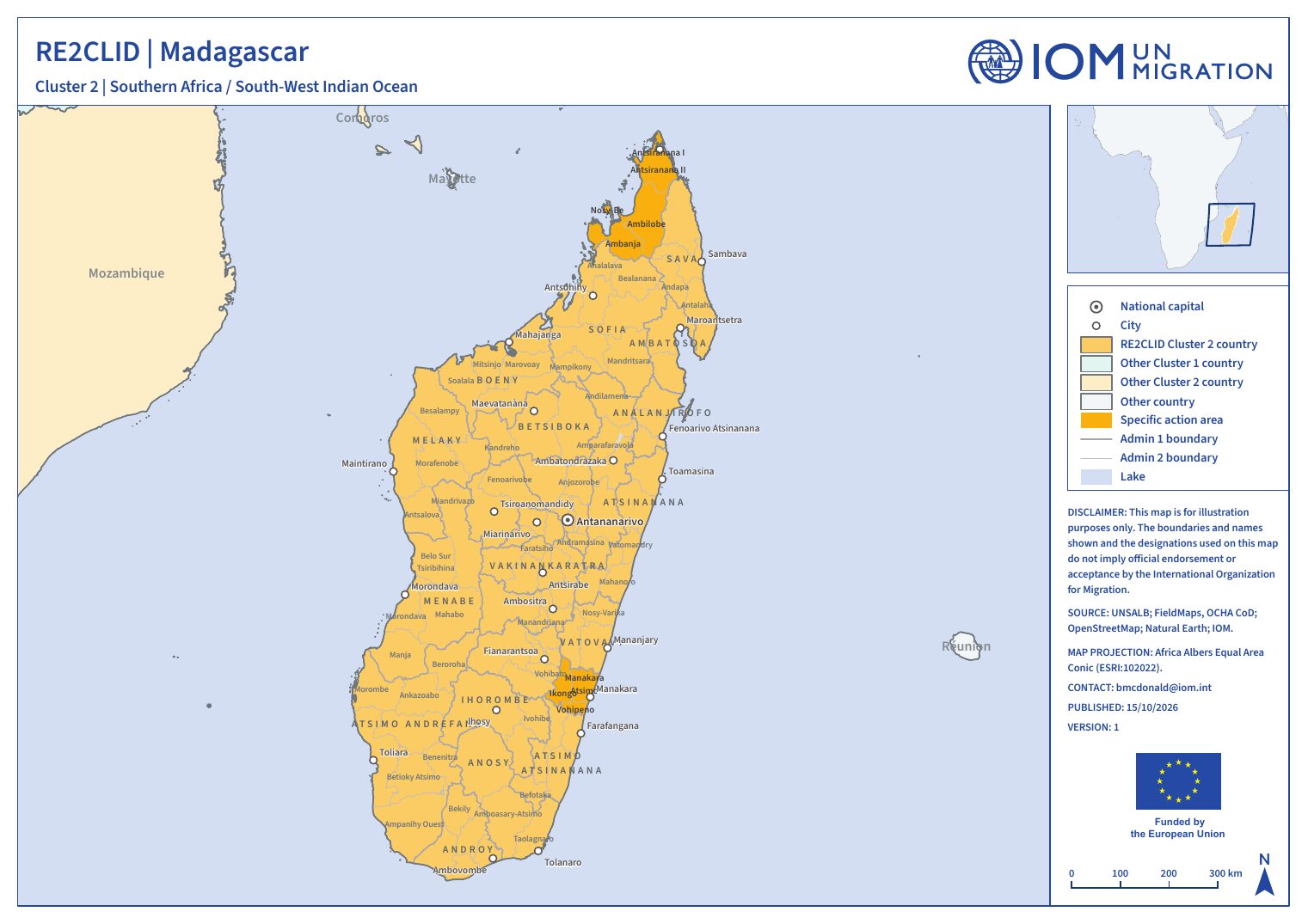
In alignment with the recommendations from the in the Framework Consultant’s Final Report (the Final Report), the Action will target the Fitovinany and Diana regions of Madagascar, with specific locations of intervention to be agreed between the Government of Madagascar, the EUD for Madagascar, and IOM. The Vatovavy Fitovinany experiences yearly displacement due to recurrent cyclones and floods, with recent disasters such as Cyclones Batsirai, Emnati, Freddy and Gamane causing large-scale destruction and displacing tens of thousands. Diana, while also cyclone-prone, serves as a key destination for internally displaced persons and persons fleeing drought and food insecurity in the Grand Sud, Diana and faces growing environmental pressures linked to the arrival of internally displaced persons and internal migrants, particularly from the drought-affected Grand Sud. Many of these newcomers settle in and around protected areas, often engaging in slash-and-burn agriculture and using land and natural resources without adhering to traditional rules established by host communities. This situation contributes to deforestation, wildfire risks, and growing tensions over natural resource use. Considering these challenges, both Vatovavy Fitovinany and Diana would benefit from the intervention. In addition, key potential implementing partners are already active in these areas, offering opportunities to develop strong partnerships and complement existing actions. The Malagsy Red Cross (with the support of IFRC and the Indian Ocean Regional Intervention Platform - PIROI) and WWF have been actively working in the region to enhance disaster preparedness, disaster risk reduction, climate resilience through nature-based solutions and community engagement. This initiative will complement EU-funded interventions in Madagascar by addressing gaps in support for nature-based solutions and inclusive governance, including the Albatros initiative.
Given the multifaceted nature of the challenges and the geographical spread of interventions in Madagascar, IOM's implementation strategy will prioritize robust partnership – including with PIROI and the Malagasy Red Cross - and localization. While IOM will provide direct technical expertise and strategic guidance, a significant portion of program delivery will be through strengthening national and local partners, including relevant ministries, local authorities, and Civil Society Organizations (CSOs) with established local presence. This collaborative approach will leverage existing capacities, ensure local ownership, and enhance the long-term sustainability and scalability of interventions. Continuous coordination with the EU Delegation and other relevant actors on the ground will be paramount for effective resource allocation and impact.
District profile summary
Districts (admin-2) in the RE2CLID action areas, with the seasonal hazards and peak-pressure months from their action-area calendar. CVA results will be added as each district analysis is completed.
| District | Admin-1 | Action units | Seasonal hazards & outbreaks | Peak pressure | CVA |
|---|---|---|---|---|---|
| Manakara Atsimo MG27210 | Fitovinany | District-wide | Cyclone season, Rainy season | Dec, Jan, Feb | Pending |
| Ikongo MG27211 | Fitovinany | District-wide | Cyclone season, Rainy season | Dec, Jan, Feb | Pending |
| Vohipeno MG27212 | Fitovinany | District-wide | Cyclone season, Rainy season | Dec, Jan, Feb | Pending |
| Antsiranana II MG71713 | Diana | District-wide | Cyclone season, Rainy season | Nov–Apr | Pending |
| Antsiranana I MG71715 | Diana | District-wide | Cyclone season, Rainy season | Nov–Apr | Pending |
| Ambilobe MG71717 | Diana | District-wide | Cyclone season, Rainy season | Nov–Apr | Pending |
| Nosy-Be MG71718 | Diana | District-wide | Cyclone season, Rainy season | Nov–Apr | Pending |
| Ambanja MG71719 | Diana | District-wide | Cyclone season, Rainy season | Nov–Apr | Pending |
Madagascar action areas
Click a district to open its profile.
- Action area (admin-1)
- District (admin-2)
Seasonal calendar
Recurring seasonal hazards, agricultural seasons, lean periods and outbreaks. Switch between the national calendar and each action area, and use the chips to filter categories.
Today. Events are recurring seasonal patterns, not forecasts.
Calendar narrative & sources
ACAPS lists 19 seasonal events for Madagascar, 9 of them limited to specific admin-1 areas (shown in brackets).
The recorded seasonal hazards are the cyclone season (Nov–Feb) and the rainy season (Nov–Apr). Planting and growing periods: Main planting – Cereal /Legumes in Fianarantsoa, Toliary (Oct–Jan), Main planting – Maize (Nov–Dec), Main planting – Rice (Nov–Jan), Main planting – Sorghum (Dec), Main planting – Rice in Antananarivo, Antsiranana, Mahajanga, Toamasina (Dec–Feb), Main planting – Wheat (May) and 2nd planting – Rice in Antsiranana, Mahajanga, Toamasina, Antananarivo (Jul–Sep). Harvests: the main harvest – Cassava in Fianarantsoa, Toliary (Aug–Oct), the main harvest – Wheat (Nov), the 2nd harvest – Rice in Antsiranana, Mahajanga, Toamasina, Antananarivo (Dec–Feb), the main harvest – Maize (Mar–Apr), the main harvest – Cereal /Legumes in Fianarantsoa, Toliary (Mar–May), the main harvest – Rice (Apr–Jun), the main harvest – Rice in Antsiranana, Mahajanga, Toamasina, Antananarivo (Apr–Jun) and the main harvest – Sorghum (May). The lean season runs from December to February in Fianarantsoa, Toliary and from March to April in Antsiranana, Mahajanga, Toamasina, Antananarivo.
The 19 records come from 2 sources dated 2016 to 2023.
- FEWS NET (2016-10-01), via ACAPS Seasonal Events Calendar. fews.net/southern-africa/madagascar/seasonal-calendar/octobe
- USDA (2023-02-01), via ACAPS Seasonal Events Calendar. ipad.fas.usda.gov/rssiws/al/crop_calendar/safrica.aspx
Madagascar country analysis
The country CVA applies the common methodology with national data and partners. It runs multi-hazard displacement vulnerability and risk assessments, and its results feed into risk-informed preparedness, DRR and adaptation planning at national and sub-national levels.
Questions the country analysis will answer
- Which districts and communities are most exposed to the main seasonal and sudden-onset hazards?
- How do socio-economic vulnerability and adaptive capacity differ between action areas?
- How can results be built into national DRM, early warning and anticipatory action systems?
Analytical dimensions
- 1Hazard
Sudden-onset (floods, cyclones, landslides) and slow-onset (lake-level rise, drought, degradation) - 2Exposure
People, settlements, infrastructure and livelihoods in hazard-prone areas - 3Vulnerability
Socio-economic sensitivity, disaggregated by sex, age and disability - 4Adaptive capacity
Services, institutions, social protection and coping strategies - 5Displacement risk
Combined likelihood and scale of disaster displacement
Outputs for Madagascar
- Analysis report · Quarto web pagePending
- Summary brief · PDFPending
- Briefing slides · Quarto Reveal.js slidesPending