
Mauritius
Mauritius faces significant risks to its economy and social development due to climate change.
Climate displacement in Mauritius
Mauritius faces significant risks to its economy and social development due to climate change. The country is highly vulnerable to adverse impacts including extreme weather events such as cyclones, storms, heavy rains, abnormal tidal surges, swells, dry spells, and floods. Although Mauritius is located in the Indian Ocean cyclone belt, it experiences limited exposure to cyclones; however, storm remnants can cause flooding, damaging buildings, crops, and livestock. According to the country's disaster risk profile, flooding is the second-largest risk after cyclones, accounting for 20 percent of direct economic losses associated with disasters. Additionally, landslides have emerged as a significant risk due to increased precipitation alongside deforestation and development on steep slopes. Other challenges include rising temperatures, decreasing annual rainfall, beach erosion, and biodiversity loss. Cyclones have also been observed to intensify over shorter periods. Weather-related hazards such as cyclones, torrential rains, flash floods, landslides, and epidemics are expected to become more frequent and intense.
The increase in disaster risk is not solely driven by climate change. Other contributing factors include rapid urbanization, tourism development in coastal areas, and the conversion of agricultural land for commercial purposes. These activities increase exposure to hazards with a higher concentration of people, property, and infrastructure in vulnerable areas like coastal zones and slopes. Unplanned urbanization and reduced vegetation cover, including forests, agricultural land, and wetlands, have also introduced new risks. Certain groups, particularly the most economically disadvantaged communities—including women-headed households, children living in urban slums, and migrants in informal settlements—are more vulnerable to disasters and their impacts, including displacement.
Read the full country context
Rodrigues has a higher proportion of its population living in poverty, greater vulnerability to disasters, and less capacity for managing disaster risks. Female-headed households constitute a significant portion of economically disadvantaged communities and are often disproportionately affected by disasters. Their homes, which are more likely to be constructed with pitched iron roofs rather than more durable concrete structures, tend to sustain greater damage during extreme weather events. This increases the risk of displacement and the need for temporary residence in evacuation sites. For example, Cyclone Gelena in February 2019 triggered flash floods and led to population displacement.
Mauritius also hosts more than 40,000 foreign migrant workers, primarily from Bangladesh, India, Nepal, and Madagascar, who often live in unstable conditions with limited access to social services. Female migrant workers are mainly employed in the garment and textile industry. During disasters, migrant workers may encounter challenges in reaching safety and accessing assistance, which increases their vulnerability. They are also likely to be excluded from preparedness and emergency response frameworks, including early warning systems. Contributing factors include language barriers, limited social networks, unfamiliarity with local risks, and challenges related to identity or travel documents. Their needs are often overlooked in national disaster preparedness and response plans.
Additionally, inter-island migration from Rodrigues to the mainland, partly driven by climate change and disasters, has led many migrants to settle in informal suburban communities. The National Migration and Development Policy (2018) emphasizes the importance of gathering mobility data, assessing its environmental impact, and evaluating disaster risk reduction strategies for immigrants, including ensuring access to information in a language they understand.
In 2020, at the request of the Government of Mauritius, the Capacity for Disaster Risk Reduction Initiative (CADRI) partnership facilitated a government-led assessment on Disaster Risk Management (DRM) systems at national and local levels. The assessment identified a series of recommendations to strengthen DRM systems in Mauritius, including measures addressing disaster displacement. The CADRI report also emphasizes the importance of addressing environmental and climate factors to prevent displacement, enabling people to remain in their communities. It also recommends improving data collection on population mobility and environmental impacts, and considering migration as an adaptation strategy for those forced to move.
Since then, multiple initiatives were implemented by partners to address gaps in DRM and Disaster Risk Reduction (DRR) capacities in Mauritius. These include the Climate Risk and Early Warning Systems (CREWS); the Resilience Build and Disaster Response Management in the Indian Ocean (RDRM-IO) co-funded by the European Union in partnership with the Indian Ocean Commission (IOC) and implemented by the IOC; the Indian Ocean Regional Intervention Platform (PIROI) and United Nations Office for Disaster Risk Reduction (UNDRR).
These initiatives have led to significant improvements of DRM systems in Mauritius. However, the integration of displacement considerations remains limited and is identified as a gap by authorities and key partners, including PIROI. Consequently, additional efforts are needed to better integrate displacement into DRM and DRR frameworks, ensure that communities are protected from displacement risks, and establish systems, protocols and infrastructure to support planned and orderly evacuations when displacement becomes unavoidable. Such measures should also ensure that the basic assistance and protection needs of vulnerable populations – both displaced and host communities – are met, and that rapid recovery is supported.
As in other Small Islands Developing States (SIDS), mobility linked to disasters and the adverse effects of climate change has been recognized as a major concern by authorities in Mauritius for more than a decade. Between 2014 and 2016, IOM partnered with six countries, including Mauritius, on the Migration, Environment, and Climate Change: Evidence to Policy (2014–2016) program, which contributed to the global knowledge base on the linkages between migration, climate, and other environmental changes, and presented policy options on how migration can serve as a climate adaptation strategy. The National Migration and Development Policy of 2018 emphasizes the need for enhanced data collection on environmentally driven mobility, a better understanding of the role of migration as a climate change adaptation strategy, and an assessment of the effectiveness of disaster risk management in addressing the realities faced by affected populations. Building on this work, IOM conducted a study in 2023 highlighting policy recommendations to better integrate migration, environment, and climate change considerations into reintegration strategies. Key recommendations from the study include strengthening cooperation between ministries and key actors for climate adaptation, expanding social protection and early warning systems in vulnerable areas, and improving data availability to support planning and adaptation.
The Regional Response to Climate Displacement in Sub-Saharan Africa (RE2CLID) aims to strengthen the institutional capacities of national and local authorities, as well as communities, to prepare for, respond to, and address climate displacement in Mauritius.
Excerpted from the RE2CLID Technical Implementation Package: Mauritius (indicative; may change during inception).
What RE2CLID will do
Disaster forecasts & displacement management
The objective of the RE2CLID project in Mauritius is to strengthen the capacities of authorities and communities to make well-informed decisions regarding displacement linked to climate change, disasters, and environmental degradation. It also seek to reinforce politically endorsed disaster risk management and climate change-related policies and programs, and to enhance capacities and collaboration among key stakeholders to tackle disaster displacement at both national and local levels, promoting coordination across institutions and departments mandated with DRR and climate change adaptation as needed.
Location selection
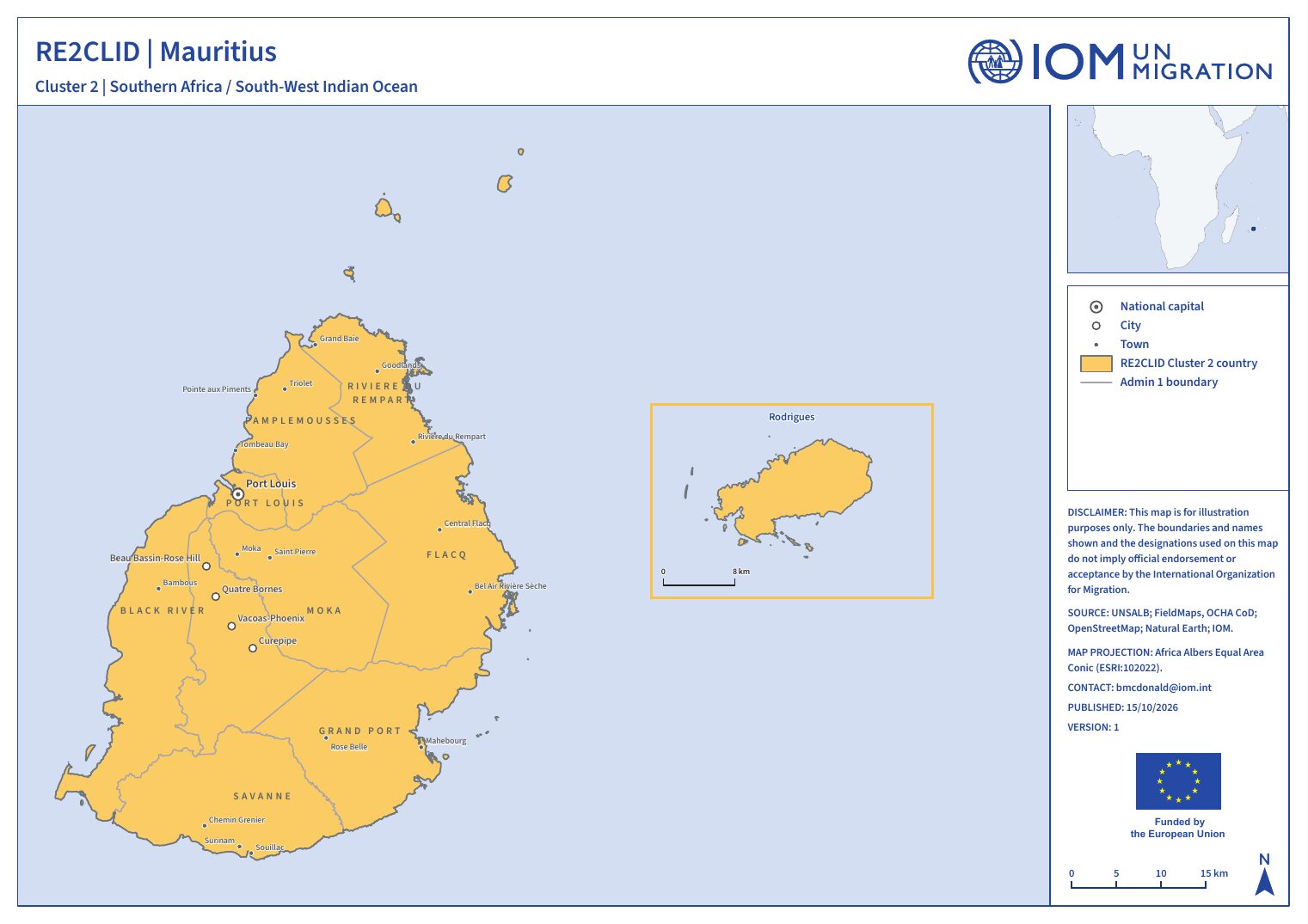
In line with the recommendations of the Regional Responses to Climate Displacement (RE2CLID) Final Report (hereinafter the Final Report), the geographic focus in Mauritius will include both mainland Mauritius and Rodrigues Island. Specific intervention sites will be determined in consultation with the Government of Mauritius, the EUD and IOM.
District profile summary
Districts (admin-2) in the RE2CLID action areas, with the seasonal hazards and peak-pressure months from their action-area calendar. CVA results will be added as each district analysis is completed.
| District | Admin-1 | Action units | Seasonal hazards & outbreaks | Peak pressure | CVA |
|---|---|---|---|---|---|
| RodriguesTIP-named · to confirm | Rodrigues | District-wide | No records | — | Pending |
Mauritius action areas
Seasonal calendar
Recurring seasonal hazards, agricultural seasons, lean periods and outbreaks. Switch between the national calendar and each action area, and use the chips to filter categories.
Mauritius country analysis
The country CVA applies the common methodology with national data and partners. It runs multi-hazard displacement vulnerability and risk assessments, and its results feed into risk-informed preparedness, DRR and adaptation planning at national and sub-national levels.
Questions the country analysis will answer
- Which districts and communities are most exposed to the main seasonal and sudden-onset hazards?
- How do socio-economic vulnerability and adaptive capacity differ between action areas?
- How can results be built into national DRM, early warning and anticipatory action systems?
Analytical dimensions
- 1Hazard
Sudden-onset (floods, cyclones, landslides) and slow-onset (lake-level rise, drought, degradation) - 2Exposure
People, settlements, infrastructure and livelihoods in hazard-prone areas - 3Vulnerability
Socio-economic sensitivity, disaggregated by sex, age and disability - 4Adaptive capacity
Services, institutions, social protection and coping strategies - 5Displacement risk
Combined likelihood and scale of disaster displacement
Outputs for Mauritius
- Analysis report · Quarto web pagePending
- Summary brief · PDFPending
- Briefing slides · Quarto Reveal.js slidesPending