
Southern Africa & South-West Indian Ocean
Climate change related extreme weather events have become more frequent over the years in the Southern Africa/South-West Indian Ocean region, placing significant stress on populations and authorities.
Climate and displacement in the cluster
Climate change related extreme weather events have become more frequent over the years in the Southern Africa/South-West Indian Ocean region, placing significant stress on populations and authorities. Designated as a climate “hotspot” by the Intergovernmental Panel on Climate Change (IPCC), it is one of the most vulnerable regions in the world in terms of climate change impacts. The region experiences a high level of climate change vulnerability not only due to hazard exposure, but also because of its high reliance on agriculture, rural livelihoods and natural resources.
During the 2022/2023 cyclone season, Comoros, Madagascar, Mozambique, and Malawi experienced recurrent shocks, leading to loss of lives and livelihoods, and triggering mass population displacement. Following the tropical cyclones Batsirai and Emnati in Madagascar in the year 2022, more than 400,000 persons were affected and around 62,000 people were internally displaced, according to the National Office for Risk and Disaster Management. Prolonged and cyclic droughts also increased the vulnerability among the extremely poor communities of the Southern Regions and triggered the displacement of 13% of the total population in the twenty most affected communities between 2019 and 2022. In the search of fertile land, people migrated towards the Northern East and Centre areas, which provided forests and low exploited soils. However, through unsustainable agricultural practices, this coping mechanism, in turn, created environmental challenges for host communities and social tensions.
Read the full cluster context
At the same time, over 700,000 people suffered from the impacts of cyclone Gombe in Mozambique, leading to the displacement of 23,000 persons. In Malawi, over half a million people were affected and more than 190,000 persons were displaced by tropical storm Ana in 2022. Following a series of almost annual climate-related devastation, Malawi witnessed devastating floods and mudslides when tropical cyclone Freddy made landfall in March 2023. Marked as one of the worst cyclones in Malawi’s history to date, more than 1,100 lives were lost, and destruction, and mass population displacement of more than 659,000 people followed in its aftermath. In Mozambique, the same cyclone affected close to 1,190,000 people and forced more than 140,000 people to seek shelter in temporary accommodation centres.
Across the Comoros archipelago, cyclone Kenneth caused major devastation in 2019, affecting more than 340,000 persons and displacing over 20,000 people. Likewise, natural hazards are also becoming more frequent and severe in Mauritius and Seychelles as climate change progresses. Coastal degradation, inadequate water resources, and loss of biodiversity increase their vulnerability to the impacts of climate change, with especially climate-sensitive economic sectors, food security and health being adversely affected.
For the past 30 years, all disaster-prone island states and territories of the South-West Indian Ocean have gradually put in place prevention and disaster preparedness measures, either at regional or national level, that have produced positive results in reducing human losses from disasters. However, during the same period, damages and losses from disasters have had a high economic and fiscal impact, with economic losses totalling up to USD 17.2 billion.
In 2023 - 2024, many parts of Southern Africa have endured the worst mid-season dry spell in over 100 years, marred by the lowest mid-season rainfall in 40 years. These El Niño-induced weather events have led to widespread crop failure, water shortages and livestock deaths. More than half of the annual harvest has been destroyed, leading to rapidly depleting stocks and increasing food prices. The drought has led to a surge in displacement, disease outbreaks and food shortages, negatively impacting national economies, and pushing an estimated 24 million in situation of crisis level of worst food insecurity.
Climate impacts are exacerbated by poverty, insufficient access to basic services, unplanned and rapid urbanization, food insecurity, ecosystem degradation, armed conflict, and violence. Furthermore, climate change exacerbates power dynamics and structures that serve to reinforce social and gendered inequalities. Specifically, women, children, the elderly, and disabled, are disproportionately affected by the impacts of climate change due to unequal access to livelihood services, productive assets, restrictive cultural norms and limited involvement in communal decision-making processes.
Yet, in countries like Malawi, principles of matriliny organized social structures in the pre-colonial period. This afforded women rights to land, property, products of labour, and children, and influence in group decision-making. The mid-19th century ushered in a period of disturbances and social transformations that led to changes in economic, political, religious, and familial practices. Changes in key institutions impacted women’s access to land and their influence in governance. In the first two decades of the 21st century, the government of Malawi responded to pressures from women’s rights advocates to legislate against gender-based violence and child marriage. However, there has been little evidence of sustained and coordinated women’s movements and activism aimed at improving women’s socio-economic status. Throughout its implementation, RE2CLID will look at traditional culture and ways to support gender-transformative access to, and distribution of, natural resources and livelihoods and address the power relationships between women and others in the communities where it will intervene.
Excerpted from the RE2CLID Description of the Action, Cluster 2, section 1.1.
Countries in Cluster 2
Malawi
→Malawi is exposed to a wide variety of natural hazards that include floods, strong winds, dry spells, cyclones, earthquakes, and landslides.
Mozambique
→Mozambique is among the countries most exposed to tropical cyclones, floods and drought in the South-West Indian Ocean basin.
Madagascar
→Madagascar faces a series of complex, interlocking challenges resulting in a multifaceted humanitarian crisis.
Comoros
→The Union of the Comoros is highly vulnerable to a wide range of natural hazards, including cyclones, floods, volcanic eruptions, and epidemics, with over 54% of its population living in high-risk areas.
Mauritius
→Mauritius faces significant risks to its economy and social development due to climate change.
Seychelles
→Natural hazards are becoming more frequent and severe in Seychelles as climate change progresses.
Cluster action areas
Click a district to open its page.
- Action area (admin-1)
- District (admin-2)
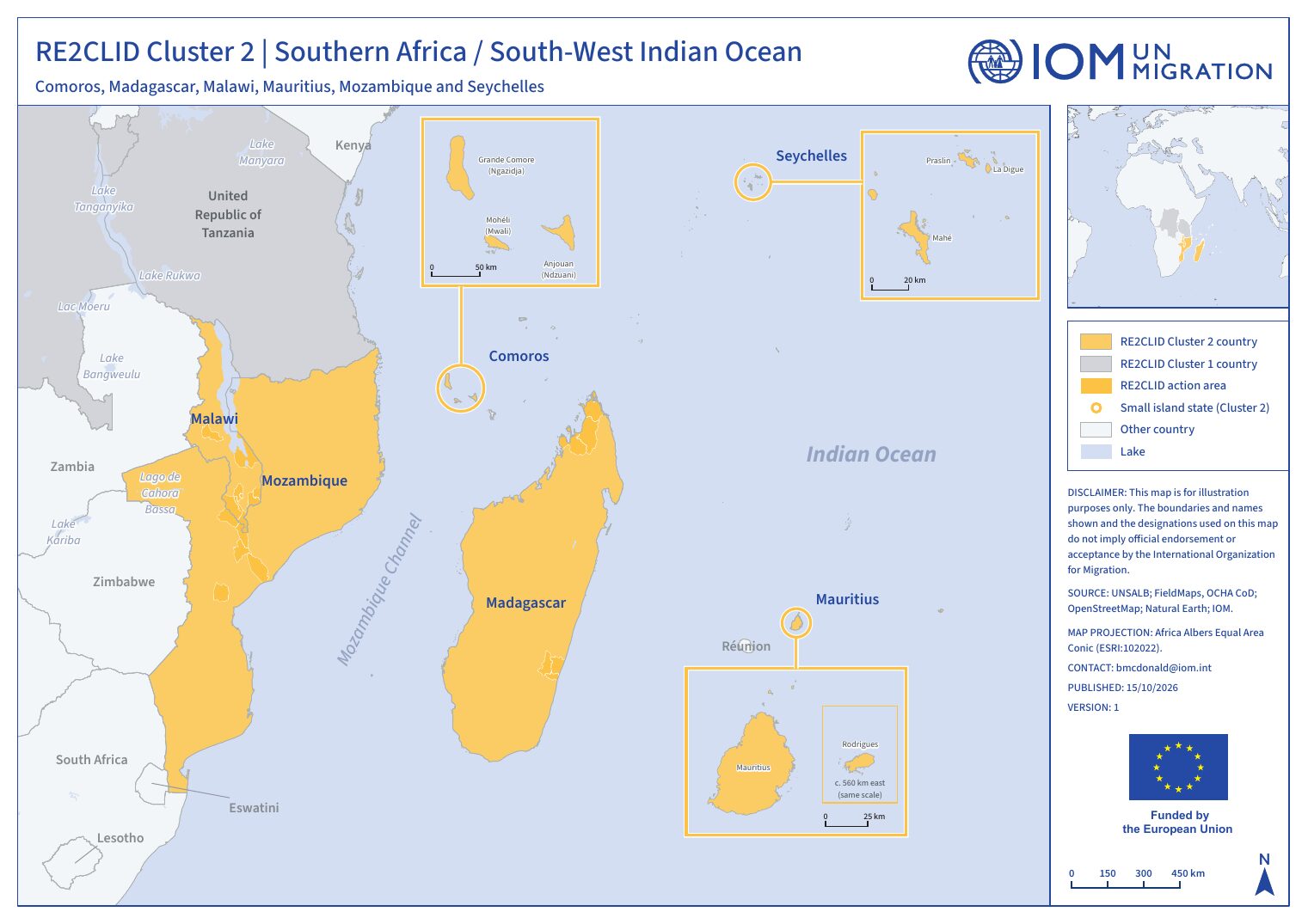
Cluster 2 analysis
The cluster CVA consolidates the country analyses into one regional view of multi-hazard displacement risk. It will feed regional policy dialogues and preparedness planning with the Regional Economic Communities, and identify where ecosystem degradation contributes significantly to displacement risk.
Questions the cluster analysis will answer
- What patterns, trends and common vulnerabilities shape displacement across the cluster?
- Where are cross-border hazards and displacement risks concentrated?
- Which regional preparedness, planned-relocation or durable-solutions measures does the evidence support?
Analytical dimensions
- 1Hazard
Sudden-onset (floods, cyclones, landslides) and slow-onset (lake-level rise, drought, degradation) - 2Exposure
People, settlements, infrastructure and livelihoods in hazard-prone areas - 3Vulnerability
Socio-economic sensitivity, disaggregated by sex, age and disability - 4Adaptive capacity
Services, institutions, social protection and coping strategies - 5Displacement risk
Combined likelihood and scale of disaster displacement
Outputs for Cluster 2
- Analysis report · Quarto web pagePending
- Summary brief · PDFPending
- Briefing slides · Quarto Reveal.js slidesPending
Seasonal pressure across the cluster
National and action-area calendars side by side. Open a country page for the full interactive calendar.
| Area | O | N | D | J | F | M | A | M | J | J | A | S |
|---|---|---|---|---|---|---|---|---|---|---|---|---|
| MalawiNational | 1 | 3 | 3 | 3 | 3 | 2 | 1 | |||||
| Malawi: CentralAction area MW2 | 1 | 3 | 3 | 3 | 3 | 2 | 1 | |||||
| Malawi: SouthernAction area MW3 | 1 | 3 | 3 | 3 | 3 | 2 | 1 | |||||
| MozambiqueNational | 3 | 5 | 6 | 6 | 5 | 5 | 2 | |||||
| Mozambique: SofalaAction area MZ07 | 3 | 3 | 3 | 3 | 2 | 2 | ||||||
| Mozambique: TeteAction area MZ05 | 3 | 3 | 3 | 3 | 2 | 2 | ||||||
| MadagascarNational | 2 | 3 | 3 | 3 | 2 | 2 | ||||||
| Madagascar: DianaAction area MG71 | 2 | 2 | 2 | 2 | 2 | 2 | ||||||
| Madagascar: FitovinanyAction area MG27 | 2 | 3 | 3 | 3 | 1 | 1 | ||||||
| ComorosNational | No ACAPS seasonal records | |||||||||||
| MauritiusNational | No ACAPS seasonal records | |||||||||||
| SeychellesNational | No ACAPS seasonal records | |||||||||||
Darker cells: more seasonal hazard, lean-season and outbreak events overlap that month. Window Oct 2026 to Sep 2027. Source: ACAPS Seasonal Events Calendar, compiled 21 October 2026.
Disaster Displacement Indicators (DDI)
The Disaster Displacement Indicators, developed by IOM and IDMC, give countries a standard way to collect, report and analyse disaster displacement, so that it can be built into DRR policy and development planning and compared across borders.
The indicators have already been piloted with the national disaster management authority in Mozambique. RE2CLID will scale up this pilot and start similar data collection in at least three SADC Member States covered by the programme, based on needs and opportunities identified during implementation.
Results will be shared through regional and sub-regional dialogues, including with SADC, and will feed the UNDRR–WMO–UNDP Disaster Tracking System and loss-and-damage processes. They will also guide RE2CLID's resilience work under Specific Objective 3.
Regional partners
RE2CLID's regional activities in this cluster are designed with these Regional Economic Communities and regional bodies:
- Southern African Development Community (SADC) and the SADC Humanitarian and Emergency Operations Centre (SHOC)
- Indian Ocean Commission (IOC)